
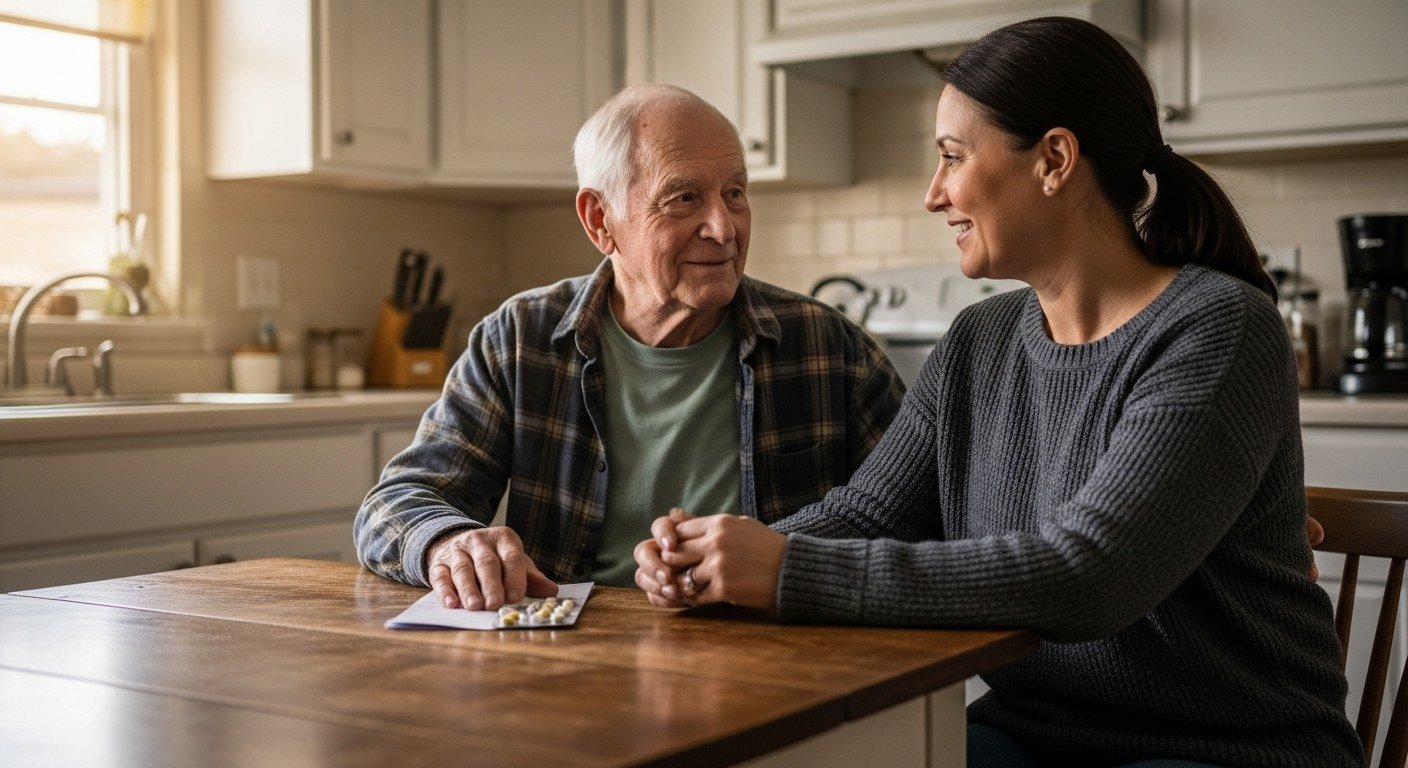
Stop asking for permission. State calmly: ‘The neurologist prescribed someone to help with the heavy lifting so I don’t hurt my back. They are here to help me, not you.’ Start the aide on tasks that don’t involve the patient, like cooking or laundry.
⚡ Quick Answer
Resistance to home care arises from a rational fear of losing independence, not stubbornness. The most effective intervention is reframing the aide as help for the *caregiver*, which bypasses the patient’s pride and denial. Ask the neurologist to formally ‘prescribe’ home care to frame it as a medical necessity.
In This Article
- Why ‘I Don’t Need Help’ Is a Rational Response to Fear
- Strategy 1: How to Reframe the Conversation to Reduce Resistance
- Strategy 2: How to Use the ‘Doctor’s Orders’ Script for Acceptance
- Strategy 3: The Smartest Way to Introduce an Aide Into Your Home
- How a Neurologist’s Prescription Can Break the Stalemate
Beyond Stubbornness: The Fear Behind ‘No’
When your loved one says, ‘I don’t need help,’ it’s rarely about stubbornness. It’s a profound, rational fear of losing the last pieces of their identity and independence. For many with Parkinson’s, accepting an aide feels like a final surrender to the disease. This resistance is a defense mechanism protecting their sense of self. Understanding this psychological root is the first step to finding a solution that preserves their dignity while protecting your own health. This is a common challenge reported by caregivers in the Parkinson’s community, and there are strategies that work.
THE UNSEEN RISK
INSTITUTIONALIZATION
If the primary caregiver is injured or becomes too ill to provide care, the patient’s only option is often immediate placement in a facility (Source: Family Caregiver Alliance, Current Guidelines).
My back is shot. Two herniated discs from transfers. We’ve hired three different aides, and my husband has sent every single one away. ‘I’m not an invalid,’ he says, then struggles for ten minutes to put on his shoes. I told my doctor last week I don’t know how much longer I can do this. I feel like a failure for not being able to convince him, and I’m terrified of what happens to him if I physically can’t lift him anymore. No one told me the ‘help’ wasn’t for him.
3 Clinical Strategies
Reviewed against current clinical practice standards.
Strategy 1: How Do I Reframe the Conversation to Reduce Resistance?
- Shift the focus entirely from the patient’s needs to your own. The aide is present to prevent caregiver injury, burnout, and collapse. (Source: Family Caregiver Alliance, Current Guidelines).
- Use “I” statements: “I need help with the laundry and cooking,” or “I am struggling to keep up with the house.” This avoids making them feel like a burden. (Source: Parkinson’s Foundation, Current Guidelines).
- Introduce the person as a “helper” or “assistant” rather than a “nurse” or “aide,” which can carry a clinical stigma of severe illness. (Source: MJFF, Current Guidelines).
💡 What You Can Do Today: Tonight, write down three non-personal tasks you need help with (e.g., grocery shopping, meal prep, cleaning the bathroom). Use this list to practice framing the conversation around *your* needs, not your loved one’s.
Strategy 2: How Can I Use the Doctor’s Authority to Gain Acceptance?
- Leverage the neurologist’s authority. A recommendation from a trusted medical professional is often perceived as a non-negotiable part of the treatment plan. (Source: Parkinson’s Foundation, Current Guidelines).
- Frame the home help as a “prescription” for the caregiver’s health. The doctor is prescribing it to protect you, the primary caregiver, from injury.
- Use this script: “Dr. Smith wrote a prescription for someone to come help *me* with the heavy lifting and household chores so I don’t injure my back. This is part of the plan to keep us both safe at home.”
💡 What You Can Do Today: Add this to your list for the next neurologist visit: ‘Please formally document in the visit summary that you recommend home care support to prevent caregiver injury.’ This gives you a physical document to refer to.
Strategy 3: What Is the Smartest Way to Introduce an Aide Into the Home?
- Start small and impersonal. The aide’s first tasks should not involve the person with Parkinson’s at all. Examples: deep cleaning the kitchen, organizing closets, running errands. (Source: Family Caregiver Alliance, Current Guidelines).
- Have the aide present during positive or neutral times, like watching a movie or having a meal together, to build familiarity without pressure. (Source: Parkinson’s Foundation, Current Guidelines).
- Only after trust and rapport are established should the aide begin assisting with patient-related tasks, starting with the least invasive (e.g., getting a drink) and progressing slowly.
💡 What You Can Do Today: Identify one task that has zero to do with your loved one’s personal care (e.g., cleaning the garage, weeding the garden). Plan to have the new helper start with only that single task for the first few visits.
Is your loved one refusing all outside help, and you are quietly running out of physical and emotional strength to keep going alone?
You don’t have to face this alone.
Which Approach Is Right for You?
The Hidden Risk: Why Caregiver Collapse Can Trigger a Financial Crisis
When a primary caregiver suffers a catastrophic health event—like a back injury from an improper transfer or a heart attack from chronic stress—the consequences for the person with Parkinson’s are immediate and severe. Without a designated and capable backup, an emergency hospitalization for the caregiver often forces an emergency placement for the patient into a nursing facility. This is not only emotionally devastating but can trigger a financial crisis, as families scramble to navigate the high costs of institutional care, often without time to plan or explore options. Protecting the caregiver’s health is the single most important strategy for keeping a loved one with Parkinson’s at home safely and affordably. (Source: Family Caregiver Alliance, Current Guidelines)
Your health isn’t a luxury; it’s the central pillar of your loved one’s entire care plan.
How to Get a Home Care Prescription from Your Neurologist
Movement Disorder Specialists and clinic social workers frequently ‘prescribe’ home care. This is not a medication prescription, but a formal, written recommendation in the patient’s medical chart and after-visit summary. When you bring up the topic, frame it around your own physical limitations and safety. Say, ‘I am concerned about injuring my back during transfers. Could you please document a formal recommendation for home care assistance to support me?’ This documentation is a powerful tool for convincing a resistant loved one that this is a medical necessity, not a personal choice. It may also be required for certain long-term care insurance claims (laws and coverage vary by state and individual plan — consult a licensed professional or SHIP counselor for your specific situation). (Source: Parkinson’s Foundation, Current Guidelines)
✅ Your Next Steps
Use this checklist to start today.
- ✅ Reframe Your Mindset: Acknowledge that your loved one’s resistance is fear-based, not malicious. This shift will change the tone of your conversations.
- ✅ Draft Your ‘I’ Statements: Write down 3-5 tasks you need help with and practice saying, ‘I need help with [task].’
- ✅ Add to Your Doctor’s Visit Agenda: Formally write down ‘Request home care prescription to prevent caregiver injury’ to discuss at the next appointment.
- ✅ Research Local Agencies: Begin looking into local home care agencies so you are prepared when the time comes. Check for those with experience in Parkinson’s.
- ✅ Join the Community: Attend a free Parkinsons.Community peer support session.
Clinical References
- Truijen S, Abdullahi A, et al. Effect of home-based virtual reality training and telerehabilitation on balance in individuals with Parkinson disease, multiple sclerosis, and stroke: a systematic review and meta-analysis. Neurol Sci. 2022;43(5):2995-3006. PMID: 35175439.
- Ge Y, Zhao W, et al. Home physical therapy versus telerehabilitation in improving motor function and quality of life in Parkinson's disease: a randomized controlled trial. BMC Geriatr. 2024;24(1):968. PMID: 39578754.
- Yang Y, Fu X, et al. The effect of home-based exercise on motor symptoms, quality of life and functional performance in Parkinson's disease: a systematic review and meta-analysis. BMC Geriatr. 2023;23(1):873. PMID: 38114897.
⚠️ Medical & Legal Disclaimer: This article is for educational purposes only and does not constitute medical advice. Consult a Movement Disorders Specialist for evaluation of Patient Resistance to Home Care Aide Introduction (Denial, Pride, Independence). Parkinsons.Community provides educational navigation support only and does not perform clinical triage.
📞 When to Call 911: If you or your loved one experiences a medical emergency — difficulty breathing, loss of consciousness, a fall with injury, chest pain, or sudden severe confusion — call 911 immediately. The information on this page is educational and does not replace emergency medical services.
FREE MEMBER BENEFIT
Caregiver Survival Is Not Selfish — It Is the Mission
You cannot pour from an empty cup. Refusing help until you collapse doesn’t serve anyone; peer support can give you the scripts and strength to make the change.
Educational support only. Never medical triage.