
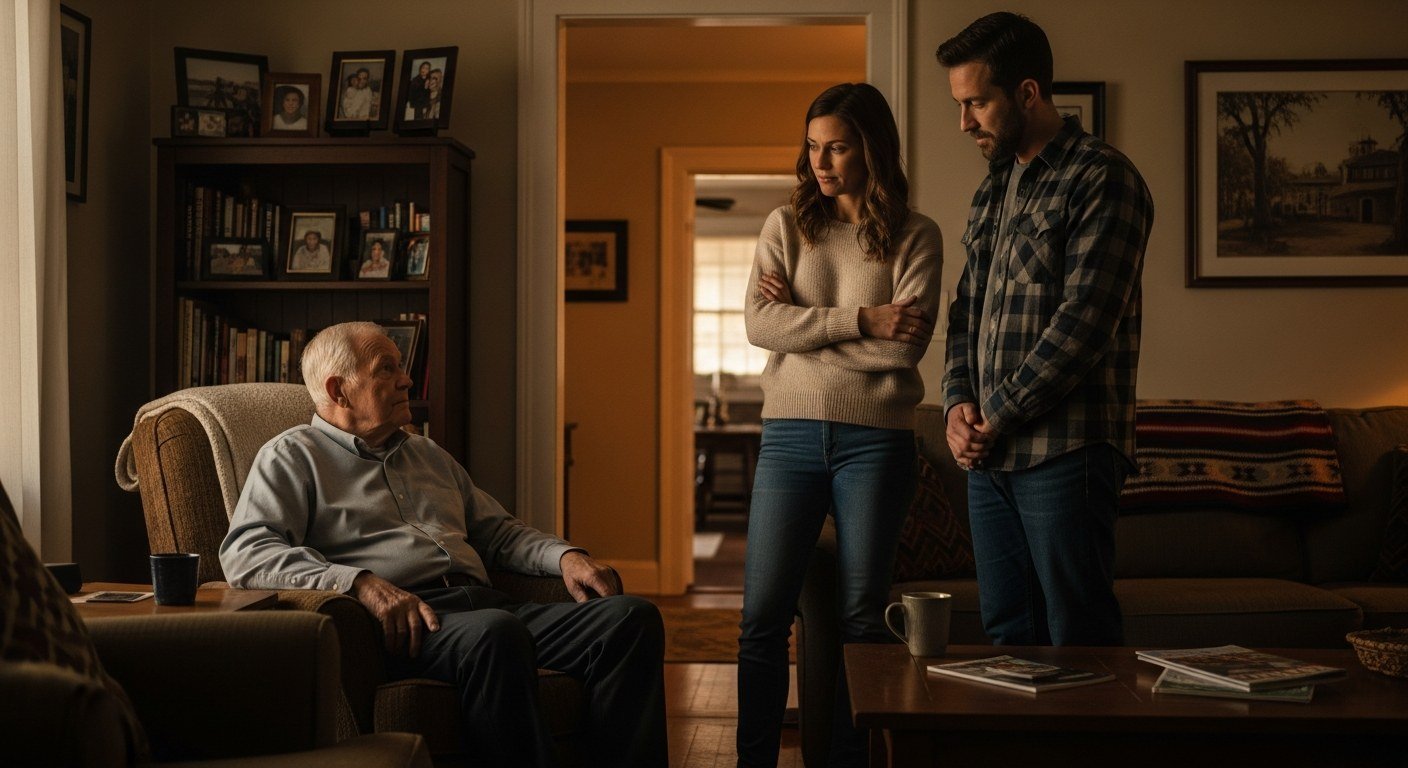
Family denial of Parkinson’s severity occurs because symptoms fluctuate dramatically between medication ‘ON’ and ‘OFF’ periods. The most effective intervention is video documentation, which provides unchallengeable evidence of ‘OFF’ states that visiting family misses. With the patient’s consent, record a 60-second video of a difficult motor symptom.
⚡ Quick Answer
Family denial of Parkinson’s severity occurs because symptoms fluctuate dramatically between medication ‘ON’ and ‘OFF’ periods. The most effective intervention is video documentation, which provides unchallengeable evidence of ‘OFF’ states that visiting family misses. With the patient’s consent, record a 60-second video of a difficult motor symptom.
In This Article
- Why ‘He Looks Fine to Me’ Is So Damaging
- Strategy 1: How to Use Video Documentation to Bridge the Reality Gap
- Strategy 2: Requesting a Neurologist-Facilitated Family Meeting
- Strategy 3: Finding Validation with Other Parkinson’s Caregivers
- Understanding the ‘ON/OFF’ Phenomenon: The Science Behind the Disbelief
They See a Good Day. You Live the 24/7 Reality.
When your brother visits for two hours on a Sunday, he sees your loved one during a medication ‘ON’ period—walking, talking, and seemingly ‘fine.’ He doesn’t see the debilitating ‘OFF’ periods you manage daily: the freezing, the tremors, the dyskinesia. This isn’t just frustrating; it’s a form of profound isolation. Family disbelief, driven by the fluctuating nature of Parkinson’s symptoms, undermines your credibility and invalidates your exhaustion. You are not exaggerating. You are witnessing a reality they are not. At Parkinsons.Community, we understand this unique crisis and our goal is to provide resources and perspectives from others who have faced it.
FLUCTUATION-DRIVEN DISBELIEF
80%
Up to 80% of individuals with Parkinson’s for 5-10 years experience motor fluctuations, creating a vastly different reality for 24/7 caregivers versus occasional visitors (Source: MDS, Current Guidelines).
I hadn’t slept a full night in months, up with his tremors and rigidity. My sister flew in for the weekend. We went to lunch, and he was ‘ON’—laughing, cutting his own food. ‘He looks great!’ she said, squeezing my arm. ‘I think you’re getting yourself worked up over nothing.’ Later, alone in the car, I just started sobbing. It wasn’t just the exhaustion; it was the feeling of being completely, utterly alone in a crisis only I could see.
3 Clinical Strategies
Reviewed against current clinical practice standards.
How Can I Prove the ‘Bad’ Moments Are Real?
- Consent is paramount: Discuss with your loved one why you want to record, framing it as a tool for better care and family understanding, not an invasion of privacy (Source: MJFF, Current Guidelines).
- Focus on a specific, challenging symptom like freezing of gait, severe tremor during an ‘OFF’ period, or dyskinesia. A 30-60 second clip is sufficient (Source: NINDS, Current Guidelines).
- Share the video in a family chat or email with a simple, neutral caption like, ‘This is what an ‘OFF’ period can look like. It typically happens around 3 PM.’ Avoid emotional commentary to let the evidence speak for itself.
💡 What You Can Do Today: Tonight, when you notice a difficult ‘OFF’ period beginning, ask your loved one for consent to record a short, 30-second clip on your phone. Do not send it yet. Just having the objective evidence is the first step to feeling more in control.
How Do I Get My Family to Listen to a Doctor Instead of Me?
- Leverage clinical authority. A neurologist’s explanation of motor fluctuations carries institutional weight that a caregiver’s emotional plea often lacks (Source: AAN, Current Guidelines).
- When scheduling, use specific language: ‘We would like to formally request a family care conference to discuss care coordination and the patient’s fluctuating symptoms.’ This signals a serious, structured meeting.
- Prepare a written list of 2-3 key questions for the neurologist to address to the family, such as ‘Can you explain the ‘ON/OFF’ phenomenon?’ and ‘What are the care needs during an ‘OFF’ period?’
💡 What You Can Do Today: Today, find the phone number for your loved one’s neurologist’s office. Write this sentence on a notepad: ‘I am calling to formally request a family care conference to discuss care coordination.’ You don’t have to call yet. Just preparing the script is a powerful action.
Where Can I Find People Who Actually Understand This?
- Caregiver isolation is a well-documented risk factor for burnout. Peer validation is not a luxury; it is a critical component of sustainable caregiving (Source: MJFF, Current Guidelines).
- Seek out Parkinson’s-specific caregiver support groups. The shared vocabulary (‘ON/OFF’, ‘dyskinesia’) means you don’t have to waste energy explaining the basics.
- Hearing another caregiver say ‘My brother said the exact same thing to me’ instantly breaks the isolation and confirms that your experience is real and valid (Source: NINDS, Current Guidelines).
💡 What You Can Do Today: Right now, open a new browser tab and search for ‘Parkinson’s caregiver online support group.’ Just seeing the results will remind you that thousands of others are facing this exact challenge. You are part of a community, even if you haven’t met them yet.
Are you the only one who sees how bad it really is — while visiting family only sees the good moments?
You don’t have to face this disbelief alone.
Which Advocacy Approach Is Right for Your Family?
The ‘Brittle’ Phenomenon: When Fluctuations Become Unpredictable
For some individuals with advanced Parkinson’s, ‘ON/OFF’ fluctuations become severely unpredictable, a state neurologists sometimes call the ‘brittle’ phenomenon. These are not smooth transitions but rapid, often dramatic shifts between mobility and immobility that can occur multiple times an hour, with little relation to medication timing. This is a neuropharmacological challenge tied to the brain’s decreasing ability to store and use dopamine. When family members witness this, it can look especially confusing, as the person may be functional one minute and completely frozen the next, furthering the sense of disbelief. Understanding this term can help you articulate the severity of the issue to medical professionals. (Source: MDS, Current Guidelines)
The ‘brittle’ phenomenon describes rapid, unpredictable motor fluctuations that defy typical medication schedules.
How to Formally Request a Family Care Conference
Do not bring this up casually at the end of a regular appointment. Call the neurologist’s office scheduler or nurse navigator separately. State clearly, ‘I am the primary caregiver for [Patient’s Name], and we need to schedule a dedicated family care conference.’ Specify who will be attending (e.g., ‘myself, the patient, and his two children’). Ask about telehealth options to include out-of-town family. Also, inquire if there is a separate billing code for this type of consultation, as it may differ from a standard follow-up. Document your request and the planned attendees in the patient portal. Rules and coverage for such meetings vary by state and individual plan—consult a licensed professional or SHIP counselor for billing questions. (Source: CMS.gov, Current Guidelines)
✅ Your Next Steps
Use this checklist to start today.
- ✅ Acknowledge Your Reality: Verbally state to yourself: ‘My experience is valid. The fluctuations are real, and I am not exaggerating.’ Validation starts with you.
- ✅ Obtain Consent: Have a calm conversation with your loved one about using video to help the family and doctors understand the full picture of their day.
- ✅ Document One Incident: Record one 30-60 second video of a challenging ‘OFF’ symptom. Do not edit it. This is your objective evidence.
- ✅ Prepare Your ‘Ask’: Draft a one-sentence email to your siblings: ‘I’ve recorded a short video to help show what Dad’s ‘OFF’ periods are like, as they often happen when you’re not here. Let me know when is a good time for you to see it.’
- ✅ Join the Community: Attend a free Parkinsons.Community peer support session.
Clinical References
- Daemen MMJ, De Bruijn-Heijligers BAAG, et al. Navigating Life With Parkinson's Disease: A Focus Group Study on Coping Strategies and Considerations for Self-Management Support. J Adv Nurs. 2025;81(4):2003-2012. PMID: 39225125.
- Pigott JS, Davies N, et al. Compound impact of cognitive and physical decline: A qualitative interview study of people with Parkinson's and cognitive impairment, caregivers and professionals. Health Expect. 2024;27(1):e13950. PMID: 39102685.
- Grandgenevre P, Warembourg F, et al. [Hypersexuality in Parkinson's disease. Advantage of the presence of the entourage for medical assessment]. Presse Med. 2015;44(3):e51-8. PMID: 25578547.
⚠️ Medical & Legal Disclaimer: This article is for educational purposes only and does not constitute medical advice. Consult a Movement Disorders Specialist for evaluation of Caregiver Isolation from Family Denial (Fluctuation-Driven Disbelief). Parkinsons.Community provides educational navigation support only and does not perform clinical triage.
📞 When to Call 911: If you or your loved one is experiencing a
medical emergency — including difficulty breathing, loss of consciousness, a fall with
injury, chest pain, sudden confusion, or any acute life-threatening symptom — call 911
immediately. The information on this page is educational and does not replace emergency
medical services.
FREE MEMBER BENEFIT
You Are Not Alone — And You Are Not Wrong
Family denial adds a layer of profound emotional and psychological weight to an already difficult journey. Connecting with peers who have navigated the same family dynamics provides immediate relief and practical strategies.
Join Parkinsons.Community — Free
Educational support only. Never medical triage.