
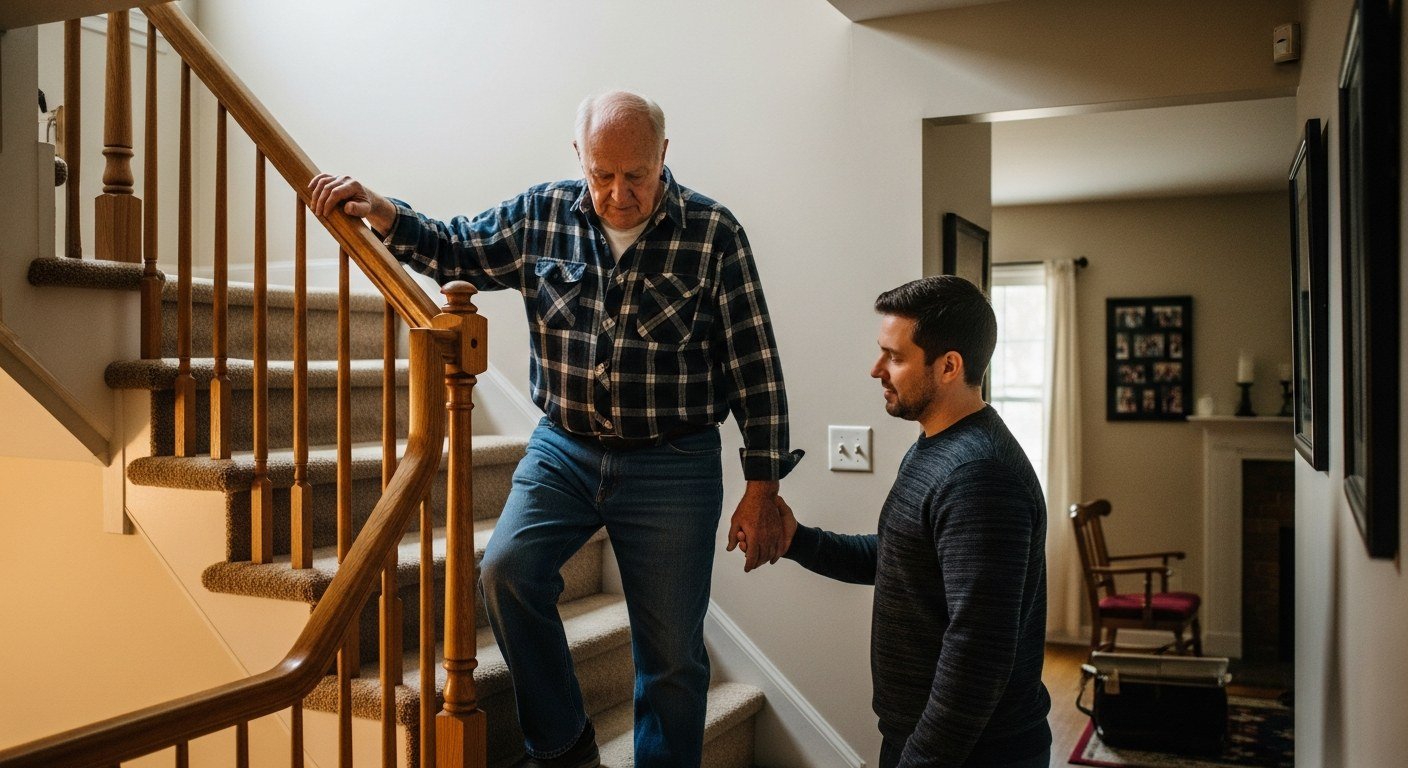
To prevent a forward fall, physical therapists teach a key technique: Do not descend facing forward. Instead, turn 90 degrees to face the handrail. Place both hands firmly on the rail, then side-step down one stair at a time, bringing both feet together on each step before moving to the next.
⚡ Quick Answer
Stair descending failure in Parkinson’s occurs because festination, an involuntary quickening of steps, shifts the body’s center of gravity dangerously forward. The most effective intervention is the PT Side-Step method, which works by turning 90 degrees to realign the center of gravity over the feet, stopping forward momentum. First, request a physical therapy evaluation for a personalized stair safety assessment.
In This Article
- How to Use the Physical Therapist’s Side-Step Technique
- Understanding the ‘Biomechanical Reset’ That Stops Festination
- How to Prepare Your Home Environment for Safer Stair Use
- Why ‘Looking Down’ at Your Feet Can Make Descending More Dangerous
- When Stairs Are No Longer Safe: Making the Right Decision
Why Do Stairs Suddenly Feel Like a Cliff Edge?
For many with Parkinson’s, descending stairs triggers a terrifying crisis. The brain signals to go, but the body’s ‘brakes’ fail. This is often due to festination, an involuntary acceleration that pushes your center of gravity forward, creating a feeling of tipping over. Your feet try to catch up, but on stairs, there’s no room. This mismatch between intent and movement can lead to freezing at the top or a dangerous, uncontrolled rush to the bottom. Understanding this biomechanical problem is the first step to regaining control. You are not alone in this fear, and there are proven strategies to help.
A CRITICAL SAFETY CHALLENGE
70%
Up to 70% of people with advanced Parkinson’s disease may experience a fall in any given year, with stairways being a high-risk environment. (Source: Parkinson’s Foundation, Current Guidelines)
She stands at the top of the landing, her hand so tight on the railing her knuckles are white. To her, it’s not a staircase; it’s the edge of a cliff. Her body wants to pitch forward, a relentless gravitational pull that her feet can’t fight. She knows if she takes that first step facing forward, she won’t be able to stop. Her husband watches from the bottom, helpless, as the terror of the fall locks her in place.
3 Clinical Strategies
Reviewed against current clinical practice standards.
Strategy 01: How Do I Use the Physical Therapist’s Side-Step Technique?
- Turn your body 90 degrees so you are facing the handrail and the wall. Your feet should be parallel to the edge of the step. (Source: APTA, Current Guidelines)
- Place both hands on the handrail for maximum stability. If there is a second rail, use both.
- Step down sideways with the foot closest to the bottom of the stairs. Plant it firmly on the step below.
- Bring your other foot down to meet it, so both feet are securely on the same step before you move again. This ‘step-together’ pattern prevents momentum from building. (Source: APDA, Current Guidelines)
💡 What You Can Do Today: What You Can Do Today: Do not attempt this on a full flight of stairs. Practice the 90-degree turn and side-step movement on a single curb or a stable aerobic step on the ground floor. Feel how turning sideways changes your balance.
Strategy 02: What Is the ‘Biomechanical Reset’ and Why Does It Work?
- Parkinson’s festination pushes your center of gravity forward, ahead of your feet. This is the root cause of the falling sensation. (Source: MDS, Current Guidelines)
- Turning sideways to face the rail immediately stops this forward momentum. It forces your center of gravity to shift back, directly over your base of support (your feet).
- This simple turn acts as a ‘reset’ button, breaking the dangerous feedback loop of leaning forward and trying to step faster to catch up. It gives the brain a new, more stable movement pattern to execute. (Source: APTA, Current Guidelines)
💡 What You Can Do Today: What You Can Do Today: Stand on a flat, clear surface. Notice how your weight is centered over your feet. Now, lean forward just enough that you feel you have to take a step to catch yourself. This is the feeling festination creates. The side-step technique prevents this initial forward lean.
Strategy 03: How Can I Prepare My Environment for Safer Stair Use?
- Ensure handrails are securely mounted on both sides of the staircase and are at a proper height (typically 34-38 inches above the steps). (Source: Parkinson’s Foundation, Current Guidelines)
- Improve lighting dramatically. Use bright, non-glare bulbs and consider motion-activated night lights or light strips along the baseboards.
- Remove all clutter. Stairs must be completely clear of shoes, books, or decorative items. Consider adding high-contrast, non-slip treads to each step to improve visibility and traction. (Source: APDA, Current Guidelines)
💡 What You Can Do Today: What You Can Do Today: Choose one staircase in your home and completely clear it of any and all objects. Wipe down the handrail. If lighting is poor, place a bright lamp at the top and bottom as a temporary measure until a permanent solution can be installed.
Has stair descending become the most terrifying part of your loved one’s day?
You don’t have to navigate these difficult safety decisions alone.
Which Approach Is Right for You?
The Hidden Risk: Why ‘Looking Down’ Makes Festination Worse
The natural instinct when you’re afraid of falling on stairs is to look down at your feet. However, in Parkinson’s, this can be counterproductive. Dropping your head to look down shifts your center of gravity even further forward, which can trigger or worsen festination. Neurologic physical therapists often coach a ‘chin up, eyes forward’ posture, encouraging you to look at a spot on the wall or the landing ahead. This helps keep your posture more upright and your center of mass stable. It feels unnatural at first, but it is a key component of breaking the forward-momentum cycle. (Source: APTA, Current Guidelines)
Your instinct to look at your feet may actually be increasing your fall risk.
When Stairs Are No Longer Safe: Next Steps
There may come a point where, even with techniques and modifications, stairs pose an unacceptable risk of a catastrophic fall. This is a difficult but critical conversation to have with your family and medical team. A formal physical and occupational therapy evaluation is mandatory to make this determination. If postural instability is severe, the clinical recommendation may be to discontinue independent stair use and consider installing a stairlift or rearranging the home for single-level living. This is not a failure; it is a proactive safety measure to preserve health and prevent a life-altering injury. (Source: Parkinson’s Foundation, Current Guidelines)
✅ Your Next Steps
Use this checklist to start today.
- ✅ Request a PT Evaluation: Ask your Movement Disorders Specialist for a prescription to a physical therapist specializing in neurologic conditions. Use this exact phrase: ‘I need a stair safety and descending technique assessment.’
- ✅ Assess Your Home: Use the checklist in this article to evaluate your staircase lighting, handrails, and clutter today.
- ✅ Discuss With Family: Talk openly about the fear and the risks. Use the comparison table to begin a conversation about long-term solutions, including the financial and emotional aspects of installing a stairlift.
- ✅ Practice on a Single Step: Safely practice the 90-degree turn on a curb or single step with supervision. Do not use a full staircase until you have been evaluated by a PT.
- ✅ Join the Community: Attend a free Parkinsons.Community peer support session to share strategies with others who are facing the exact same challenge.
Clinical References
- da Conceição NR, Teixeira-Arroyo C, et al. Influence of Parkinson's Disease on Judging Stair Step Height: Exploratory Study. Percept Mot Skills. 2019;126(1):106-118. PMID: 30501375.
- Jones SV, Waltz C, et al. Characterizing Stair Ambulation Kinetics and the Effects of Dual Tasking in Parkinson's Disease. J Clin Med. 2025. PMID: 40869655.
- Roth N, Ullrich M, et al. Real-World Stair Ambulation Characteristics Differ Between Prospective Fallers and Non-Fallers in Parkinson's Disease. IEEE J Biomed Health Inform. 2022;26(9):4733-4742. PMID: 35759602.
⚠️ Medical & Legal Disclaimer: This article is for educational purposes only and does not constitute medical advice. Consult a Movement Disorders Specialist for evaluation of Stair Descending Failure (Festination and Forward Momentum Crisis). Parkinsons.Community provides educational navigation support only and does not perform clinical triage.
🚨 When to Call 911: If your loved one experiences a fall with head injury, loss of consciousness, difficulty breathing, chest pain, severe confusion, or any life-threatening symptom — call 911 immediately. Do not wait. This information is educational and does not replace emergency services.
FREE MEMBER BENEFIT
Fear of Stairs Doesn’t Have to Mean Loss of Independence
Losing safe access to parts of your home is a profound challenge. Our community offers a space to discuss these tough decisions, from PT strategies to the logistics of home modifications.
Educational support only. Never medical triage.